Sunday, March 08, 2009

Pulling it all together online -- LibGuides? Netvibes? Pageflakes?

Research resources -- shared and organized in easily configured widgets/modules on tabbed pages -- that's what libraries using Web 2.0 tools like LibGuides, Netvibes, and Pageflakes can offer their customers. It's one of the quickest ways to create a library portal or home page.

LibGuides is not free, but it looks like it could be worth buying.

Check out the LibGuides Community page where you can browse for academic, public, and school libraries and see how they have used the product.

For example, see the library guides created by:
Buffy (alias The Unquiet Librarian) recently blogged about how much she loves LibGuides and she's someone who has been exploring the best means of providing students with research guides and pathfinders for some time now -- see her wiki: Research Pathfinders 2.0: Information Streams for Students.


Netvibes is the next best option -- and it's free. This is what I've been playing with for the past few weeks, inspired by these librarians:

The beauty of Netvibes is that anything I see on any of their pages, I can easily copy to my own by simply clicking "Share" on a particular widget. And everyone has both a private page and a public page, so you can play around with customizing widgets on your private page and then move them to the public sphere.

For example, I just copied over links to kids' magazines from Fiona, links on books and reading from Leanne, more book and reading links from Yvonne, links to audio book sites from Dianne, and dictionary websites from Kathy.

I like how Kathy has made a separate page for the PYP units of inquiry -- and I'll be doing that as well, but for now here's my initial effort:


Pageflakes is a similar tool that I have experimented with before, but then I recently read a blog posting which suggested Pageflakes might die (from lack of funding). So I immediately began exploring Netvibes and was thrilled to find so many good library examples out there to copy. But then just the other day there was an ominous blog posting about Netvibes! Well, I'm not giving up on Netvibes yet. But as a form of insurance I've also just requested a proper LibGuides demo (and formal quote). By the way, this is the official comment on costs:

The cost of an annual license depends on the size of your institution and the number of libraries involved. We try to customize the pricing for every client, to meet their specific needs (as well to fit within their budgets!). The annual license fee ranges from $899 to $2,999 ($549 for K-12 libraries). Most libraries would fall under the lower license range. Contact us with the info about your institution (FTE or # of card holders) and we'll give you an exact quote. Chances are, you'll be pleasantly surprised - LibGuides is a great deal, any way you look at it!
I haven't mentioned iGoogle personalized pages, though they're quite similar. You can also share widgets and tabs with other people, but they're designed more for personal homepages -- where someone is logged into their Google account. So if your students all have iGoogle pages, then you could publicize library-specific widgets for them to add to their homepages. And if you want to explore other options, see this list of "start page" tools via Delicious.

Speaking of library websites, there are two I've admired recently for their clean "Mac" look and layout, though only Leanne's was made on a Mac. The other was created using a free tool called Weebly.


p.s. Check out the screencasts/tutorials The Big House Library has made using Jing (a free screen capture/screencast tool) showing how to use their library catalog (Follett's Destiny). I plan to do the same (someday).

Sunday, February 15, 2009

Improving the inquiry process

Photos from Flickr: istlibrary
Learning from peers is powerful -- in the classroom and in life. I often get my share early on a Saturday morning, thanks to Skype and Beth Gourley, my friend and fellow teacher-librarian. When our video cameras come into focus, the difference in our locations is obvious. Beth, up in Tianjin, China, at this time of year is wearing a thick bathrobe and huddled under a duvet, while I, down in Singapore, lounge in sleeveless nightwear, cooled by a ceiling fan.

This week's treasures from Beth included an article she wrote last year for KnowledgeQuest called "Inquiry -- The Road Less Travelled" (Vol. 37, No. 1, Sept/Oct 2008) and some related photos. Unfortunately, the article is not yet available online, but should be eventually (and you could always write Beth and ask her to send you a copy.... )

In the article she describes the International School of Tianjin (an IBO school) and how the teaching team there has worked on improving inquiry in the classrooms and library, starting with a group exploration of inquiry and information literacy models.

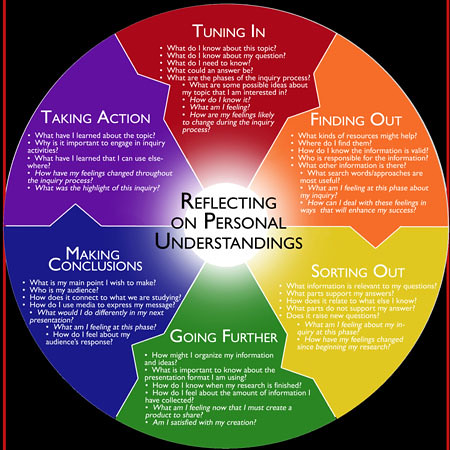
The result was a model adapted from three major sources: the spiral of making personal meaning and understanding from Barbara Stripling (2003), guiding questions from Jennifer Branch and Dianne Oberg (2005), and language from Kath Murdoch (2005). The secondary school version is shown above, and they have a similar one with simplified questions for the elementary school.

I especially love how teachers use the model as a framework for documenting the units of inquiry. Here is an example from one of their Kindergarten classes (click to enlarge):


When Kath Murdoch came and worked with their teachers last year, they did a reflective exercise on their implementation of inquiry. Here is a partial summary of the remarks collected (also taken from the article):

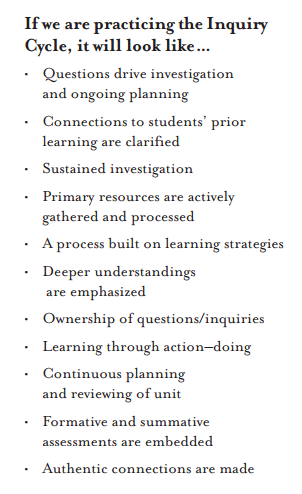
They go on to create the list (below left).

Nothing radical there -- everyone struggling to improve their inquiry will recognize the items as common goals. Still it's good to be reminded of them.

Beth is also working on a wiki called Research Story, based on their inquiry model (which I trust she won't mind me sharing). Like all wikis, it's a work in progress. But I know it's made me want to go back and re-organize my own grade-level wikis around an inquiry model.


NB: The inquiry cycle image at the top was developed at the International School of Tianjin (IST) in 2007.
Sources for the image compilation-- as taken from the IST Flickr page:
Stripling, Barbara K. 2003. “Inquiry-Based Learning.” In Curriculum Connections through the Library, ed. Barbara K. Stripling and Sandra Hughes-Hassell, 3-39. Westport, Conn: Libraries Unlimited. Murdoch, Kath. 1998. Classroom Connections: Strategies for Integrated Learning. Ar-madale, Vic: Eleanor Curtain Pub.Branch, Jennifer, and Dianne Oberg. 2005 “Focus on Inquiry.” IASL. (accessed 6 May 2007).

Thursday, January 01, 2009

Inspiring Libraries

Libraries are a natural source of inspiration for the curious and creative.

Listening to Paul Holdengraber, the Director of the New York Public Library's Public Program Series, is an inspiration in itself. Here are my notes on an interview filmed with him in 2007.
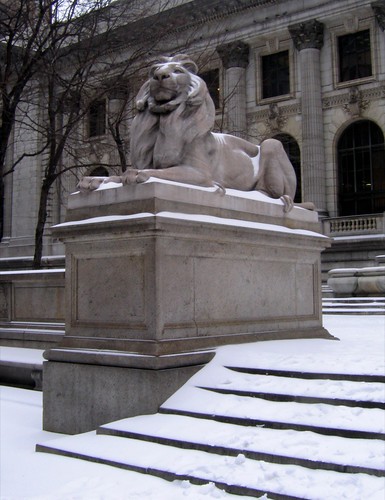
His job is to "oxygenate" the New York Public Library -- to make the famous lions outside "roar" -- to create a library without walls.
We need to make people think it's sexy to think -- that there should be both information and inspiration. We have to free the books. To have a thought is to caress our brains. Thinking is exciting!

Inspiration comes mainly from arguments around the kitchen table. We need each other desperately as humans (e.g., you can't tickle yourself). A library is a space of conviviality -- which can help us get references in common. We all need something to talk about.

Curiosity is one of the most important things we can arm ourselves with in life -- if we're not curious at 20, we'll be boring at 50. We must inspire curiosity -- to be interested in the world -- to have interests -- something to replenish our minds.
The blog Design*Sponge has done a couple of videos showing how a librarian at the New York Public Library has inspired five different artists -- a glassblower, a letterpress printer, a maker of ceramic dishes, etc. -- with material from the library's collection, whether images in books or artifacts themselves -- maps, old postcards, prints, etc. See the videos on the NYPL webpage: Design by the Book.

Similarly, Jay Walker is a man who believes a library should have objects to inspire -- as well as books. There is a 7-minute TED video of him showing off some of the treasures in his amazing private library: Jay Walker: A library of human imagination -- including an Enigma machine, a flag that's been to the moon and back, and a real Sputnik satellite.

Wired did an article on his library not long ago -- Browse the Artifacts of Geek History in Jay Walker's Library - with plenty of photos. Go check it out.

I'm going to end with a plug for the book I think should be in every library -- as a source of inspiration: Alan Fletcher's The Art of Looking Sideways (2001), which has been described as "the ultimate guide to visual awareness, a magical compilation that will entertain and inspire all those who enjoy the interplay between word and image, and who relish the odd and the unexpected. "

Fletcher, a famous British graphic designer, is now dead, but here's a YouTube video of him talking about his unusual book.


Flickr photo credits: lion: MacRonin47; library: jamesjk ; Jay Walker library

Curiosity: a close cousin of creativity

Robert McKee, in his book Story: Substance, Structure, Style, and the Principles of Screenwriting, presents curiosity as the intellectual need to answer questions and close patterns -- a universal desire which story plays to by doing the opposite, posing questions and opening situations.

Olivia Judson, scientist and New York Times blogger, sees curiosity as the defining characteristic of the best scientists and as something that must be caught, not taught:
In schools, science is often taught as a body of knowledge — a set of facts and equations. But all that is just a consequence of scientific activity.
Science itself is something else, something both more profound and less tangible. It is an attitude, a stance towards measuring, evaluating and describing the world that is based on skepticism, investigation and evidence. The hallmark is curiosity; the aim, to see the world as it is. This is not an attitude restricted to scientists, but it is, I think, more common among them. And it is not something taught so much as acquired during a training in research or by keeping company with scientists.
Ryszard Kapuscinski, the Polish journalist and author who died a couple of years ago, argues for this same centrality of curiosity for historians and journalists (who are really just current historians) -- exemplified by Herodotus.

Kapuscinski kept company with him by carrying around a copy of Herodotus's History throughout his years as a foreign correspondent, and he describes the influence Herodotus had on him in his 2004 book, Travels with Herodotus (which I highly recommend as an introduction to either Kapuscinski or Herodotus).

Here are snippets from the book:

In Herodotus's days, the Greek word "history" meant something more like "investigation" or "inquiry".... [Herodotus] strove to find out, learn, and portray how history comes into being every day, how people create it, why its course oftens runs contrary to their efforts and expectations. [p. 257]

    What set him in motion? Made him act? .... I think that it was simply curiosity about the world. The desire to be there, to see it at any cost, to experience it no matter what. It is actually a seldom encountered passion. [p. 258]
    To be a conduit is their passion: therein lies their life mission. To walk, ride, find out -- and proclaim it at once to the world. There aren't many enthusiasts born. The average person is not especially curious about the world.... So when someone like Herodotus comes along -- a man possessed by a craving, a bug, a mania for knowledge, and endowed, furthermore, with intellect and powers of written expression -- it's not so surprising his rare existence should outlive him. [p. 267]

Seth Godin, the business/marketing guru, has a short video on the importance of being curious -- a desire to understand, a desire to try, a desire to push the envelope. He also believes the curious are a minority and laments that the educational system does not (cannot?) promote it.

Can curiosity be described as having an agile mind? (like Cliff Stoll in his TED talk "18 Minutes with an Agile Mind")

Is curiosity the skill of being interested in the world? Randy Nelson, dean of Pixar University, in a short video on learning and working in the collaboration age (which is definitely worth watching), talks about Pixar looking for employees with four attributes: 1. Depth, 2. Breadth, 3. Communication, 4. Collaboration.

Number 2: "Breadth" relates to being a curious person, though Nelson defines it as the skill of being interested. He argues it's easy to find people who are interesting, but tough to find those who are more interested than interesting. These are the people you want to talk to, he says, not because they're clever, but because they amplify "me", they want to know what I know -- they lean in when I talk and ask me questions.

Pixar is one of the companies highlighted in the book Mavericks at Work: Why the Most Original Minds in Business Win -- by William C. Taylor & Polly LaBarre (2006).

Nelson is quoted there on the same subject:

"We've made the leap from an idea-centered business to a people-centered business. Instead of developing ideas, we're developing people. We're trying to create a culture of learning, filled with life-long learners. It's no trick for talented people to be interesting, but it's a gift to be interested. We want an organization filled with interested people." [p. 230]

Isn't that what we all want?

Apture