A question every school librarian must face is, to cover? or not to cover? In plastic.
For our new library, I choose to buy hardcovers whenever possible -- only adding a plastic layer to books with dust jackets where the jacket alone carries a front cover image (i.e., when the hardcover itself is plain). Any paperbacks I buy are being left as is. No sticky-back plastic -- of any kind.
It's a decision of cost -- of the plastic, of the labor spent attaching the plastic, and to the environment which must live with the plastic for its lifetime.
A similar question every school/teacher must face is, to laminate? or not to laminate? My friend Pam Duncan, a head librarian in control of the school's laminating machine, has single-handedly managed to significantly reduce her school's plastic footprint by insisting staff justify each and every act of lamination to her personally.

-- Poster by John Blyberg (CC-Attribution); hat-tip Michael Stephens and then LibraryThing;
FYI: created using Despair, Inc.'s Parody Motivator Generator
Does plastic convey authority? And does it allow users to abdicate personal responsibility? As Tim from LibraryThing comments (on the above poster):

On the other hand, books may rapidly become completely recyclable so when that meatball sub falls onto it, you just pop it in the back of the "recycler/fabricator" that we'll have in our homes -- and produce a new copy (or print out a different book).
Witness the all-plastic, waterproof, completely recyclable book, Cradle to Cradle: Remaking How We Make Things, a manifesto calling for ecologically intelligent design.
Watch these two short videos and think how far we have come:

You can't talk about digitizing all the books in the world without mentioning the latest e-book readers, like the Kindle (thanks to John Blyberg for another photo). Kahle and others tout the $100 laptop as a great device for reading e-books. Watch Robin Ashford demonstrate it on YouTube below. (I don't think I'm going to be able to resist buying one....)
Want to read more about the future of books (and publishing and writing)? First, subscribe to if:book, the blog of the Institute for the Future of the Book. Second, you might enjoy reading "The 21st Century Writer" and the accompanying interviews of Tim Reilly, Douglas Rushkoff, Stephen Abram, and Frank Daniels, published in The Futurist (July/August 2008 issue online).
For our new library, I choose to buy hardcovers whenever possible -- only adding a plastic layer to books with dust jackets where the jacket alone carries a front cover image (i.e., when the hardcover itself is plain). Any paperbacks I buy are being left as is. No sticky-back plastic -- of any kind.
It's a decision of cost -- of the plastic, of the labor spent attaching the plastic, and to the environment which must live with the plastic for its lifetime.
A similar question every school/teacher must face is, to laminate? or not to laminate? My friend Pam Duncan, a head librarian in control of the school's laminating machine, has single-handedly managed to significantly reduce her school's plastic footprint by insisting staff justify each and every act of lamination to her personally.

-- Poster by John Blyberg (CC-Attribution); hat-tip Michael Stephens and then LibraryThing;
FYI: created using Despair, Inc.'s Parody Motivator Generator
Does plastic convey authority? And does it allow users to abdicate personal responsibility? As Tim from LibraryThing comments (on the above poster):
I've wondered if lamination and similar protective techniques in libraries don't encourage the very disaster they anticipate—"Oh, the book has a plastic cover on it? I guess that means its okay if I read it while eating a meatball sub!"I know I'm doing lots of talking with students about their responsibility to respect books, given that we're not exerting any extra effort to give books extra protection. (Responsibility and Respect are two key terms in the PYP.)

On the other hand, books may rapidly become completely recyclable so when that meatball sub falls onto it, you just pop it in the back of the "recycler/fabricator" that we'll have in our homes -- and produce a new copy (or print out a different book).
Witness the all-plastic, waterproof, completely recyclable book, Cradle to Cradle: Remaking How We Make Things, a manifesto calling for ecologically intelligent design.
To eliminate the concept of waste means to design things -- products, packaging, and systems -- from the very beginning on the understanding that waste does not exist.Intentionally recyclable physical books aren't that prevalent yet, though we do have the ability to print and bind paperback books from scratch in minutes, via machines like the EBM (Espresso Book Machine) -- at a cost of a US$0.01 per page.
(p. 104, Cradle to Cradle)
Watch these two short videos and think how far we have come:
- 1947 video "Making Books" produced by Encyclopedia Britannica Films in collaboration with the Library of Congress -- a classic black and white informational video showing how books used to be produced -- from the author's manuscript to typesetting to lines to composed pages to copper plates, printing, binding, covering, etc. (Thanks to the graphic artist student Golden Krishna for discovering this precious piece of history -- and my apologies that I can't trace now who led me to his website...)
- The Espresso Book Machine -- in action!
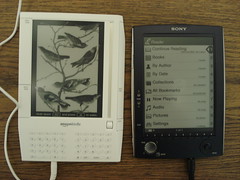
You can't talk about digitizing all the books in the world without mentioning the latest e-book readers, like the Kindle (thanks to John Blyberg for another photo). Kahle and others tout the $100 laptop as a great device for reading e-books. Watch Robin Ashford demonstrate it on YouTube below. (I don't think I'm going to be able to resist buying one....)
Want to read more about the future of books (and publishing and writing)? First, subscribe to if:book, the blog of the Institute for the Future of the Book. Second, you might enjoy reading "The 21st Century Writer" and the accompanying interviews of Tim Reilly, Douglas Rushkoff, Stephen Abram, and Frank Daniels, published in The Futurist (July/August 2008 issue online).
I always thought that publishing was about, first of all, understanding what matters, figuring out how to gather information and then gathering readers who that information matters to. There’s a kind of curation process. What the Internet has done is bring us new methods of curation.
-- Tim Reilly


